For a lighting brand, importer or project supplier, choosing the right manufacturing model is not only a purchasing decision. It affects product ownership, development cost, lead time, certification planning, inventory pressure and long-term market differentiation.
The terms ODM, OEM and private label are often used casually, but they describe different levels of engineering responsibility and buyer involvement. A clear choice helps both sides prepare drawings, samples, testing plans, packaging requirements and shipment inspection criteria before production starts.
Send your application, ceiling condition, beam angle and dimming requirements for a practical review.
What ODM, OEM and private label mean in LED lighting
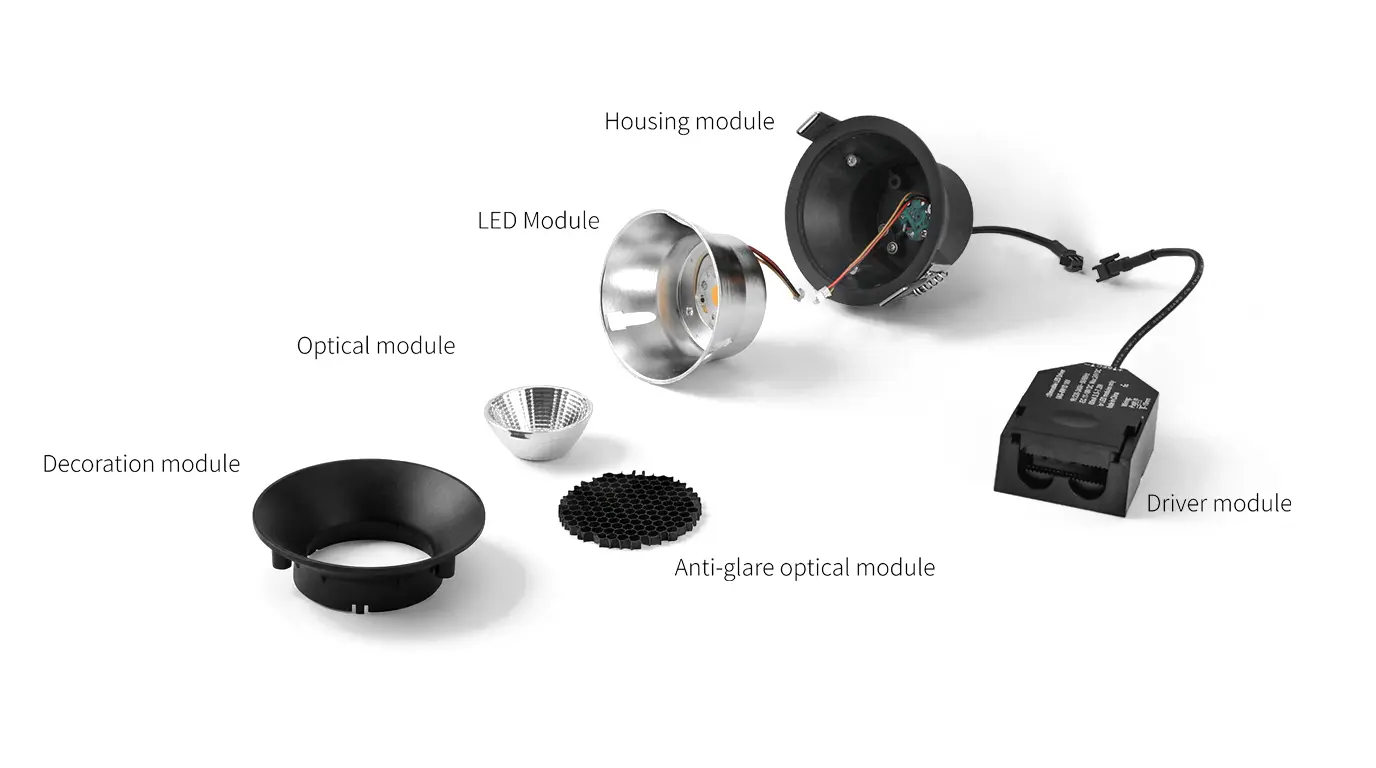
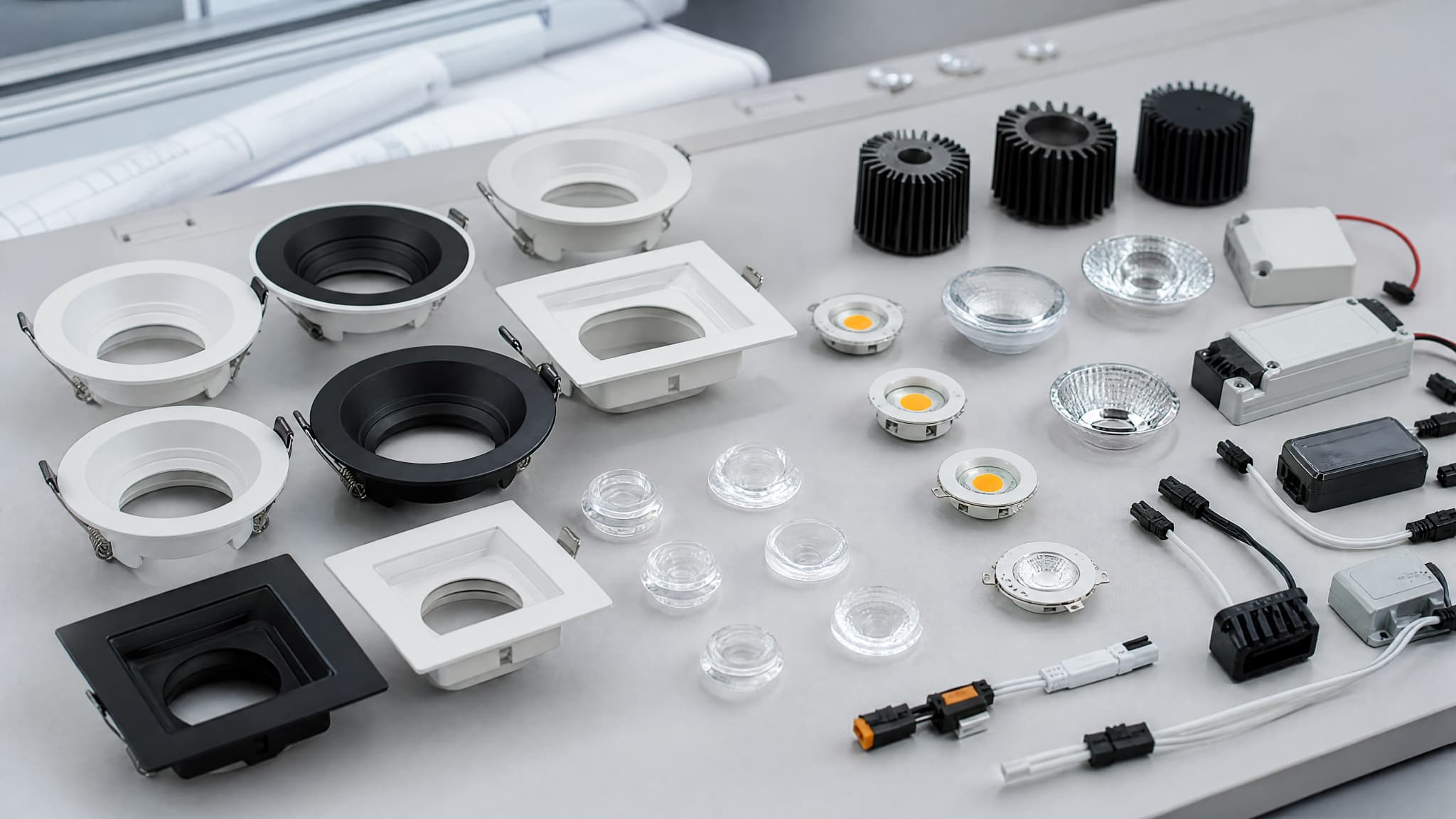
ODM means the manufacturer provides an existing or semi-developed product platform that can be configured for the buyer. In LED lighting, this may include a modular LED engine, downlight housing, trim, reflector, driver option and packaging system. The buyer selects the configuration and may request adjustments to finish, CCT, CRI, beam angle or branding.
OEM usually means the buyer brings more defined product requirements. These may include industrial design direction, target dimensions, optical performance, driver protocol, installation accessories or market-specific compliance needs. The manufacturer supports engineering, sampling, factory testing and production based on those requirements.
Private label is the fastest and lightest model. The buyer uses an existing product with brand labeling and packaging changes. It can be useful for catalog expansion, market testing or small-volume launch programs, but it usually provides less technical differentiation.
| Model | Buyer involvement | Typical advantage | Typical limitation |
|---|---|---|---|
| Private label | Low | Fast launch with lower development cost | Limited differentiation |
| ODM | Medium | Flexible configuration based on a proven platform | Some design boundaries remain |
| OEM | High | More control over product definition | More time, sampling and coordination required |
When ODM is the practical middle path
ODM is often the best fit when a buyer wants a distinctive product range but does not want to start from a blank sheet. A modular downlight platform, for example, can support different trims, beam angles, CRI levels and driver protocols without creating a completely new fixture for every project.
This approach is useful for importers and lighting brands that need to respond to hotel, retail, gallery and office projects with speed. Instead of holding many finished SKUs, the buyer can work from a shared LED engine and configure the visible trim, optical accessories and driver system according to project requirements.
In factory communication, ODM projects still require detailed confirmation. The buyer should define the target market, application, expected quantity, dimming system, packaging method and any installation constraints before sampling.
- Use ODM when the market needs flexibility but the launch schedule is still important.
- Ask whether the LED module, housing, driver and optical accessories are independently configurable.
- Confirm what can be customized without changing tooling or extending the development schedule.
When OEM gives better control
OEM is suitable when the buyer has a clear product strategy and needs more control over appearance, mechanics or performance. This may include a specific trim structure, special installation method, custom reflector finish, private model requirement or integration with a defined control system.
The benefit is differentiation. The trade-off is that the project needs a more disciplined development process. Drawings, prototypes, thermal review, optical evaluation, packaging checks and shipment inspection should be planned as part of the project timeline.
Professional buyers should avoid treating OEM as a simple quotation request. The more complete the brief, the more accurate the technical recommendation and cost estimate will be.
A buyer checklist before choosing the model
Before selecting a cooperation model, compare the commercial goal with the technical workload. A catalog extension may only need private label. A regional product platform may be better handled as ODM. A long-term brand asset may justify OEM development.
It is also important to ask how the supplier handles factory testing and shipment inspection. For LED lighting, consistent CCT, beam distribution, driver compatibility and visual finish matter as much as the first sample.
- Define target application: hospitality, retail, office, gallery or residential project.
- List required CCT, CRI, beam angle, IP rating and dimming protocol.
- Clarify packaging, labeling, catalog data and installation document needs.
- Agree sample approval criteria before mass production.
- Confirm inspection points for appearance, electrical safety, optical performance and accessories.
How ANOVA fits into the decision
ANOVA focuses on modular LED lighting platforms for commercial and architectural applications. This makes ODM and OEM cooperation more practical because the LED engine, housing, trim and driver can be discussed as a system rather than as isolated components.
For buyers who need a structured start, the existing LED module and downlight categories provide a baseline for product application discussions. For buyers with more specific market requirements, the OEM/ODM route can help define optical, mechanical and driver choices before production.
Conclusion
There is no single best manufacturing model for every lighting business. Private label is efficient, ODM balances speed and differentiation, and OEM provides the greatest control when the buyer is ready for a deeper development process.
The right decision starts with a clear product brief, realistic timing and a supplier conversation that includes engineering, testing, packaging and shipment inspection.